

In 1989, the five original members of Poco reunited for an album and a tour, but it wasn’t without problems.
Poco 1969 -1989


“We had so much left to do as Poco.” – Randy Meisner, 19911

It was founding member Rusty Young who first had the idea to reunite Poco. In July 1986, he told New York DJ Pete Fortanale about his idea of an “alumni” reunion of all previous members of Poco. Rusty had contacted his former band members about the idea, including Randy,2 but the project was eventually scrapped because the other members weren’t available, and possibly because they couldn’t find a record label that was interested.
But another event occurred later that same year that would help make the reunion a reality. It happened when Richard Marx’s manager, Allen Kovac, and producer, David Cole, asked Randy to sing backup on a song on Marx’s debut album. The track was called “Don’t Mean Nothing.” It would also feature backing vocals by former Poco bassist Timothy B. Schmit (who also took Randy’s place in the band) and slide guitar by Joe Walsh. Randy also helped Marx promote the single by appearing on an MTV special along with Schmit.
Recording “Don’t Mean Nothing” at Capitol Studios in L.A.
Source: @therichardmarx/Instagram


Fast forward to 1988. Although Poco never officially broke up, the band had not played a gig since the summer of 1987. Rusty Young was the only original member left, along with longtime member, Paul Cotton. Rusty felt the time was right to revisit the Poco “alumni” project. He contacted Jim Messina & Richie Furay, who were interested in the idea. Although, it was eventually decided that they would reunite the original five members from 1968, there was reluctance, especially on Rusty’s part, not to invite longtime member Paul Cotton, who had been such an integral member of the band for nearly 20 years, and Timothy B. Schmit, who had replaced Randy in 1970.
Rusty Young:
“We talked about doing the original five, we talked about doing everybody – all seven, including Paul Cotton and Tim Schmit with the five originals. To be honest, Tim wasn’t really interested. But it didn’t matter because that really wasn’t the concept we wanted anyway.”
Jim Messina recalled his conversation with Timothy:
“I spoke with Timmy, and Timmy had a reluctance to becoming a part of it. I’ll paraphrase what I remember that he had spent a lot of time in the band, there was a lot of water under the bridge, and it was just not something he wanted to revisit.”3
As for Paul Cotton. At the time of Legacy, he was working on his first solo album, Changing Horses, so it was just not the right time. “A lot of fans looked for me in that project,” he told Poco biographer Jerry Fuentes “but it just didn’t work out.”
Poco reunited, 1989

Since 1987, Randy had been a member of the The Roberts-Meisner Band, a collaboration with his friend Rick Roberts, formerly of The Flying Burrito Brothers and Firefall. The band played club and festival dates, mostly along the West Coast, with hopes of eventually cutting an album. But the latter never came to pass and the band wasn’t as successful as either had hoped it would be. So when Randy was contacted about the Poco reunion, as well as the hefty six-figure bonus the record company apparently offered, it was an opportunity he couldn’t refuse.4
With the original members of Poco in place, they got together at Jim Messina’s Santa Barbara studio to rehearse.
Randy:
“We just sat down and played a little bit, just to see if it felt right. We each had a song that we played, and everybody just sort of joined in. It sounded great. We decided, ‘Yeah, we should do this again.'” 5
A Pogo Reunion
The 1989 Poco reunion was really a reunion of Pogo. The original group from 1968 was known as “Pogo” during Randy’s entire six-month tenure, except for a couple of early appearances as R.F.D. The name change to Poco occurred in April 1969, after Randy had already left the band.6 The 1989 reunion would mark the first time that Randy would record and perform with the band under the name Poco.
“Pogo” in Rolling Stone, March 1st, 1969

To produce Legacy, Poco went with David Cole, who had also produced Richard Marx’s debut. It was also decided by RCA that a Marx song, “Nothing To Hide,” would be on the album and he would produce it. Early on, Marx had expressed interest in producing the entire Legacy album, not just one song. Messina, who had produced Poco’s first three albums, including Pickin’ Up The Pieces, was, naturally, against the idea:
“We thought it would be impossible for Richard to do the whole album. We are fairly seasoned fellows… What we wanted was someone who had total experience as a producer, as an engineer, someone who had a relationship with a lot of musicians around town, and someone who was mature enough to work with any problems that could arise, and I think David Cole is really the best choice. 7
Messina further stated that he didn’t want Legacy “to be a Richard Marx album.” 8
Pastor Richie Furay
Richie Furay left the music business behind in the early 1980s to devote his life to the church. In 1983, he became the pastor of the Calvary Chapel in Broomfield, CO.9 Although he was excited about the prospect of a Poco reunion, he was also worried about how it would affect his position as pastor of a church. Initially, the the other band members were willing to work with him, but things hit a snag when Richie began insisting that every aspect of the album had to coincide with his Christian values. This would affect not only the record, but also the subsequent tour.
Recording
Poco entered the studio in March 1989. Richie, Jim, and Rusty had submitted songs to RCA for consideration. Outside material was also included. Randy did not submit any new material for the album. “When we did Legacy,” he said, “I didn’t have any time.” 10 This was possibly due to the fact that he was still touring with the Roberts-Meisner Band, and was actually a member of both bands until the summer of 1989.
RCA listened to the demos and decided which songs Poco should record. The band members experimented with lead vocals, with each member taking a shot at a song to see which vocal was the best fit.
Although, drummer George Grantham was part of the reunion, he was unable to participate in the sessions, except on backing vocals. In George’s absence, Gary Mallaber, formerly of the Steve Miller Band, and Jeff Porcaro, co-founder of Toto, were brought in to play drums.

“Call It Love”
“Call It Love” was chosen as the first single off of Legacy. It was written by Ron Guilbeau, Billy Crain, and Rick Lonow. RCA felt it was the track with the biggest hit potential. During the recording, Richie had a problem with one of the song’s original lyrics, which he deemed “pornographic.” The problematic line was (ahem): “I make you wet, you make me sweat.” 11
Richie Furay:
“If you would have heard the original lyrics, it was essentially, ‘Call It Lust,’ and it wasn’t Poco. We never wrote songs like that.” 12
Furay refused to be involved with the song unless the lyrics were changed. So, with the writers’ permission, Jim Messina reworked the line to suit Richie, and was given a writing credit on the song.
Although “Call It Love” was sung by Rusty Young on the album, a recording exists of Randy singing lead on the track, with the original risqué lyrics. Randy gave a copy of the recording to radio personality Richard Randall in 1995. As Richard told me, Randy “sang it better.” 13
RCA hired Michael Bay to direct a music video for “Call It Love,” as well as their next single, “Nothin’ To Hide.” Bay filmed the band lip-syncing to the songs and would later add a narrative story to accompany the videos. The lip-syncing footage for “Call It Love” was filmed on the first floor of L.A.’s old Fire Station 23, which has not been an operational fire house since 1960, but has been used as a popular filming location for several TV shows and movies since the 1980s, most notably Ghostbusters.
Predictably, Richie was aghast at the story portion of the video:
“I received a copy of the ‘Call It Love’ video. With anticipation and excitement, I popped it into my VCR and sat down with Nancy to watch. After all, this was the band’s first video. But Nancy and I were startled by what we saw. The story portion of the video took place in a little shack in the desert, and the men inside were hosing down a bunch of women. It looked like a wet T-shirt contest.”14
Official video for “Call It Love”
“Call It Love” became a Top 20 hit on Billboard’s Hot 100, peaking at #18 on November 4th, 1989.
“Nothin’ To Hide”
Randy’s lead vocals were featured on three songs on Legacy: “Nothin’ To Hide,” “Rough Edges” and “Nature Of Love.”
“Nothin’ To Hide” was the only song on the album produced and co-written by Richard Marx. According to Randy, Marx had written the song with him in mind. He also asked Randy to help finish it:
Randy:
“Richard asked me to finish the song, but I was working on the road with another band at the time and by the time I got back into L.A., I didn’t have enough time to really think it out more, so he went ahead and finished it.” 15
“Nothin’ To Hide” would be Legacy‘s second single, released in December 1989.


Poco and Richard Marx in the studio.

Photo:@therichardmarx/Instagram

L-R: Marx, Randy, Rusty, George, and Richie
Official video for “Nothin’ To Hide”
“Rough Edges”
“Rough Edges” was a collaboration between Rusty Young and country duo Foster & Lloyd (Radney Foster & Bill Lloyd). The three met when Rusty was touring as a member of Vince Gill’s band in 1986.16
Bill Lloyd posted the following on his Facebook page after Randy’s death, along with the photo below:
“RIP Randy Meisner. Only met him a couple of times but I can say he was a nice fellow and I surely loved his voice and songs (‘Certain Kind of Fool’ from Desperado was always a favorite). He sang ‘Rough Edges’ on the Poco Legacy album in 1989 which was a song written by Rusty Young, Radney Foster and myself…With Poco, Rick Nelson’s Stone Canyon Band and, especially, The Eagles, Randy certainly made his mark and left the world with great recordings. Here’s a photo from a RCA party in 1989 where Rusty, Randy, Radney and I are doing ‘Rough Edges’ in an impromptu acoustic performance on a riverboat going up the Cumberland! Thank you Randy (and Rusty).”

Here’s Randy singing “Rough Edges” at The Bottom Line in Nagoya, Japan on October, 22nd, 1990. “Rough Edges” was their show opener for the 1990 tours.
“Nature Of Love”
Written by Van Stephenson and Jeff Silbar, “Nature Of Love” was chosen as the third single off of the album. It was released in February 1990 to coincide with the start of the Legacy tour. The CD single included an “Open-Ended Interview” with Randy, Jim, and Rusty conducted by Canadian radio broadcaster, John Donabie.
CD Insert (front and back)


CD Insert (inside)

Listen to the John Donabie interview below:
Randy can be heard three times during the interview at 6:53 – Trying out for Poco in 1968, 10:37 – Picking vocalists for songs, and 14:05 – Working with Richard Marx on “Nothing To Hide.”
Neither Richie Furay nor George Grantham were very enthusiastic about “Nature Of Love.” “I really didn’t think that song fit,” recalled George. Richie, not surprisingly, took issue with the original lyrics, which contained the line: “Some will find it on their wedding day. Some in the backseat of a Chevrolet.” Richie called co-writer Van Stephenson and asked if he would alter the lyrics.17 After some wrangling, Stephenson eventually acquiesced, and the problematic lyric was changed to: “Some will find it on their wedding day. Some will never give their hearts away.”
Official video for “Nature Of Love”:
Legacy Release
Full-page ad for Legacy, Rolling Stone, October 5th, 1989

Legacy was released in August 1989 on vinyl, CD and cassette. The CD version included an extra track, written and sung by Jim Messina, called “Look Within,” which was not available on the vinyl version.18
Artwork – An SNL Connection
The “running horse” logo first appeared on Poco’s 1978 Legend album. It was designed by Phil Hartman, who was the brother of Poco’s manager, John Hartmann, who had also managed the Eagles in the early ’70s. Phil would later gain fame as a comedian and Saturday Night Live cast member from 1986-1994. But, in the 1970s, he worked as a graphic designer, creating album covers for his brother’s clients, including Poco & America, as well as a logo for Crosby, Stills & Nash. Hartman also designed the horseshoe cover for Poco’s Seven album in 1974. Both the running horse and horseshoe have become logos for Poco that are still used today.19
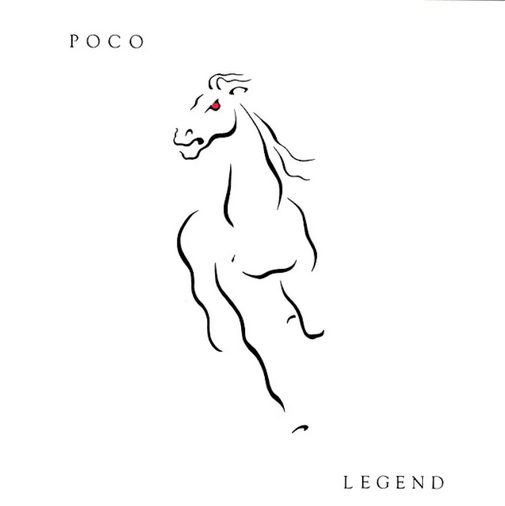
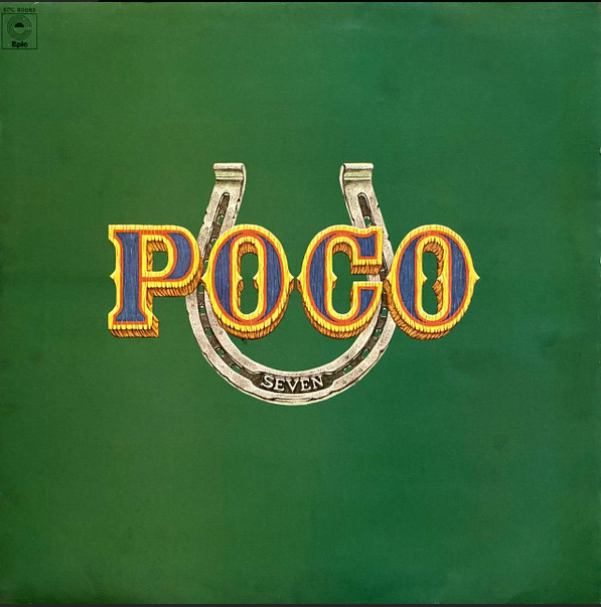
Cover of 1978’s Legend, designed by Phil Hartman.

Front and back of the Legacy album, with running horse logo. The band photo on the back was taken by Jim Shea, who had also photographed Randy for his solo debut in 1978.


Album inner sleeve with artwork and lyrics:


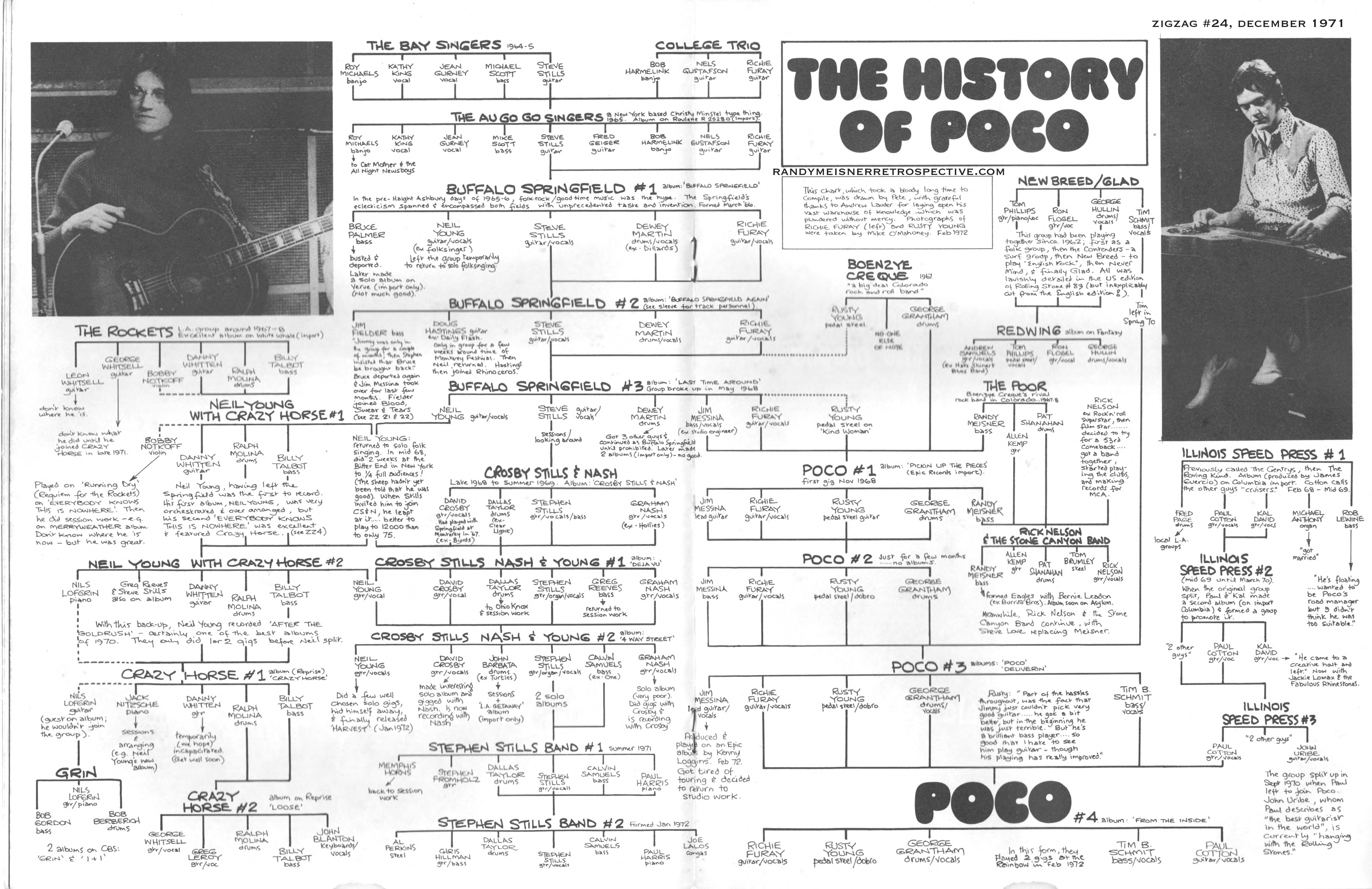
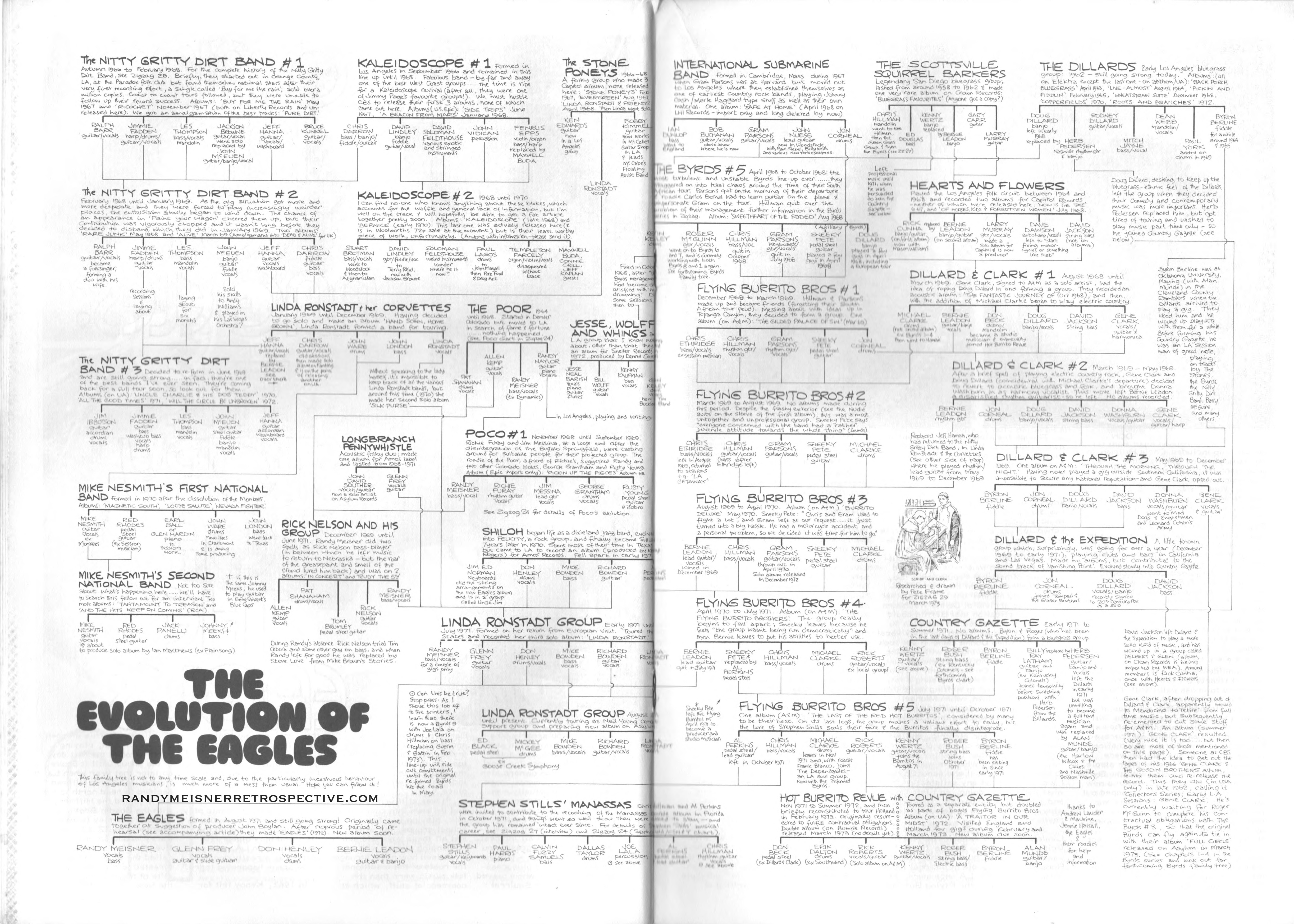
A “Poco Family Tree” was commissioned as a promo item for the Legacy‘s release. It was created by Pete Frame, whose rock family trees were a popular feature of Zigzag magazine, which he founded in 1969.20

Legacy was certified gold on March 9th, 1990. 21

In the Fall of 1989, Poco, made a number of radio and TV appearances in support of Legacy. They also traveled to Europe to promote the album, minus Richie. One of these appearances was in Amsterdam, where they appeared on the Countdown TV show, as well as the 2 Meter Sessies (Sessions) radio show, produced by Jan Douwe Kroeske. Here is audio of Poco singing “Crazy Love” from the radio show. This video was created by Peter Van Leeuwen, who attended the session and took photos of the band, which accompany the recording:
Legacy Tour
Poco set out on a three-week U.S. tour in January 1990, opening for Richard Marx. It kicked off on the 24th in Pittsburgh, PA at the Palumbo Center. See a full listing of tour dates here.
Critics: More Poco, Less Marx
Many critics of the tour couldn’t help but point out the dichotomy of having seasoned pros like Poco opening for a newcomer like Marx, especially one who was seen by many as nothing more than a teenybopper pop star trying to pose as a legit rocker. The reviews of the 1990 concerts are as entertaining as they are brutal. Music critics are the ultimate rock snobs, and nothing sets them off like a poser. As Dean Johnson of the Boston Herald noted, the difference between Richard Marx and Poco was like “the difference between a lot of hot air and a cool breeze on a muggy day.” For these critics, it wasn’t enough that they had to suffer through Marx prancing around on stage half-dressed, they also had to listen to his songs. “His rock formations are about as exciting as Cheez Whiz,” noted Russell Karns of the Des Moines Register. “They are also just about as substantial.” Therefore, it’s no surprise that a lot of older fans came to these shows to see Poco, then left after their set was over. Evidently Marx had a flashy show, and he tried his best to come off as a real rock bad-ass on stage, but it was a bit too contrived. The Pittsburgh Press offered my favorite description of Marx’s hackneyed stage antics “There he is ending songs with his head thrown back and his fist in the air like he’s just slain a dragon.”


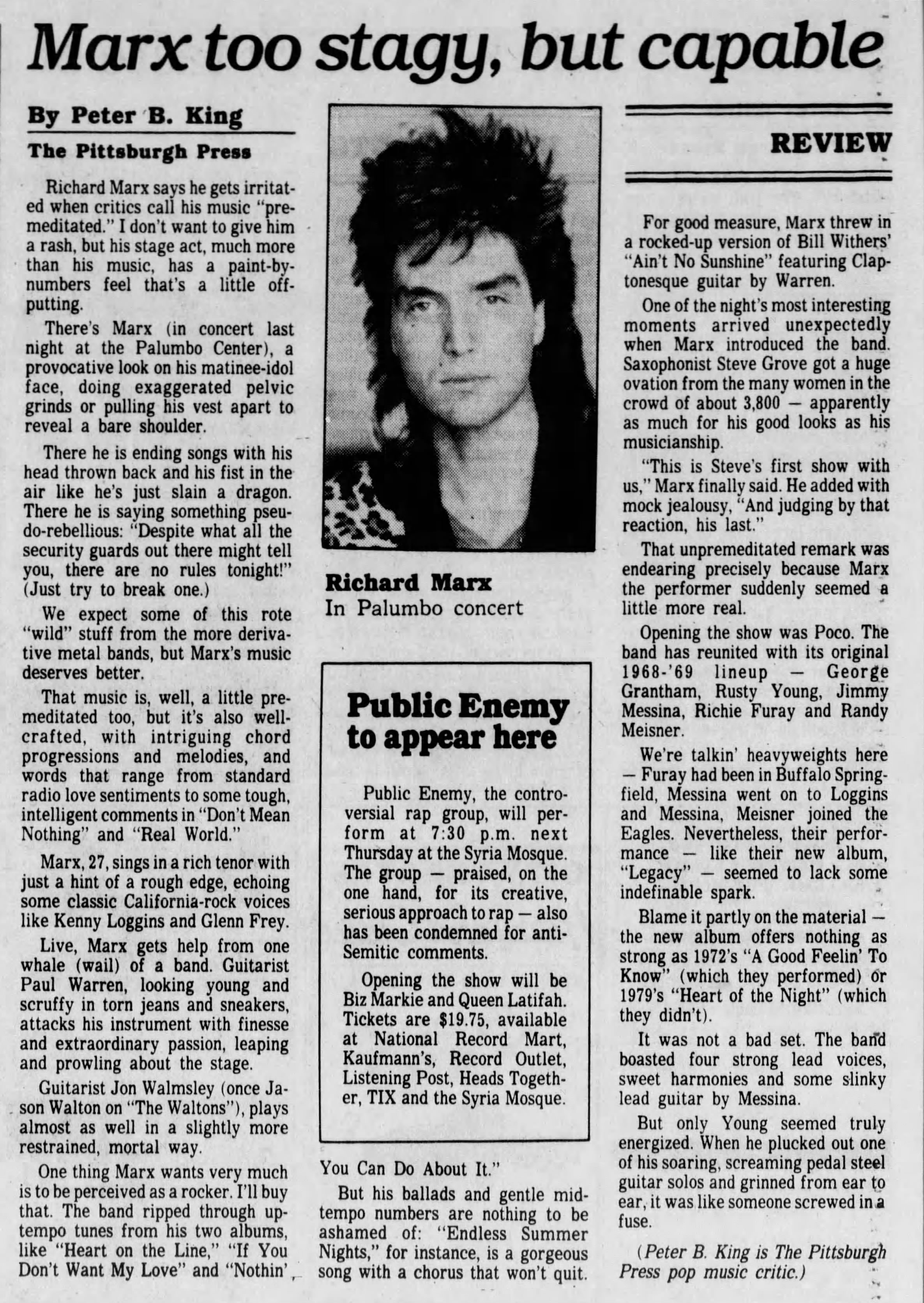
Below: An example of one such review from the New York Post, February 12, 1990. Critic Gene Santoro said Richard Marx’s set at Radio City Music Hall was about as much fun as “root canal work.” On the other hand, he thoroughly enjoyed Poco’s performance, in which they received a standing ovation. “A rare feat for an opening act.”

However, Poco’s live show was not without problems. Part of their set included famous songs from the past careers of its members. For instance, Randy sang his Eagles hit “Take It To the Limit,” as well as songs from his solo albums, such as “Hearts On Fire.” Jim Messina performed the Loggins & Messina hit, “Your Mama Don’t Dance.”
Randy and Richie onstage, Winter Park, CO, July 7, 1990

Once again, Richie had a problem with lyrics. This time it was a line from “Hearts On Fire,” which included the verse: “Had myself a tall one waitin’ at the bar/I wasn’t gonna leave here/ ’til I had her in the car.” As Randy recalled: “That really got to Richie. He thought of it as screwing a girl.” 22 To suit Richie, the lyric was changed to “I didn’t want to go too far.” 23
Richie also had a gripe about a line in “Your Mama Don’t Don’t Dance,” which was a hit for Loggins & Messina in 1972. The lyric in question was: “You pull into a drive-in/And find a place to park/You hop into the backseat/Where you know it’s nice and dark.” Like Randy, Jim changed the lyrics out of respect for Richie.
But remembering to sing these new lyrics became a problem for Randy and Jim.
Randy:
“One night, Richie was glaring at me and wouldn’t talk to me. I didn’t know why. I found out later I forgot and sang the original words. It was by no means meant to be malicious. I apologized.”24
For Jim, a similar lyric flub had a more lasting impact. It occurred when the band appeared at Farm Aid in Indianapolis on April 7th, 1990. Messina described the incident to Poco biographer Jerry Fuentes:
“I had agreed to change the lyric (in ‘Your Mama Don’t Dance.’) I’m singing the song like I’ve done for twenty years, and I go on autopilot and sing the wrong lyrics. And Richie comes absolutely unglued. I don’t know what to say. It certainly wasn’t something I did on purpose.”
Jim and Richie had angry confrontation about the incident on the bus and Messina stormed off in anger. It would be years before the two would reconcile.25
Watch Poco’s set at Farm Aid below:
“Good Feelin’ To Know”
“Take It To The Limit”
“Crazy Love”
“Your Mama Don’t Dance” (with Randy saying “Get out the car, long hair” at 6:08)
Summer 1990 Tour
When Poco set out on a summer tour in July 1990, it would be without Richie Furay, who felt he could no longer continue with the band and chose to focus on his church duties.26 Former Poco member, Jack Sundrud, was brought back as a replacement, along with keyboardist David Vanacore. Poco was the headliner for several dates on this tour. By August, they had joined the Marlboro Music Tour, where they were co-billed with .38 Special and Angel Train. A number of these dates had been scheduled on military bases, but due to the Persian Gulf War, which began in the summer of 1990, a number of the troops from these military bases had been deployed.
Randy:
“Part of our tour was military bases. The minute we go out, the first thing we find out is that they’re having a war in the Persian Gulf. So, you go to these places and there’s 25-30 people on the whole military base, where normally there would have been thousands and thousands of people–and we end up with 25 people.”27
Ad for Poco at Fort Huachuca in Sierra Vista, AZ, August 31, 1990

Poco in Houston, August 27th, 1990

Summer 1990 tour setlist:
Rough Edges
What Do People Know
Nature Of Love
Lovin’ You Every Minute
Rose Of Cimarron
Spellbound
Crazy Love
Follow Your Dreams
One More Song
Who Else
You Better Think Twice
Hearts On Fire
Take It To The Limit
Your Mama Don’t Dance
Call It Love
Midnight Flyer
In October 1990, Poco was invited by Japanese promoters Kaz & Associates to kickoff their ’70s Classic Rock series, which kicked off at the Nakano Sun Plaza on October 19th.


Watch Randy performing “Nature Of Love” at the The Bottom Line in Nagoya on October 21st, 1990:
The Forgotten Trail
In October 1990, Epic Records released a 2-CD compilation called The Forgotten Trail (1969-1974). It featured songs from Poco’s first eight albums on Epic, as well as alternate takes, remixes and unreleased tracks. Randy is featured on five songs from Pickin’ Up The Pieces, including a remix of “First Love.”

Possible Legacy Follow-Up
In early 1991, Poco began putting together material for a possible follow-up to the Legacy album. Drummer George Grantham had departed at the end of the Legacy tour due to “personal issues.” So only Jim, Rusty, and Randy remained. This time around, Randy wanted to contribute his own material. He’d begun working on six musical tracks that Robin Le Mesurier had given him.28 Randy was adding lyrics and melodies to the tracks.29 Altogether, Randy, Jim and Rusty had contributed about 30 songs for the next album. They even considered using a different band name going forward. 30
Jim, Rusty, and Randy. Photo from Randy’s personal collection.
Courtesy of the Estate Of Randy Meisner. Used with permission.

Acoustic Tour
In the Spring & Summer, Poco went on a short tour as an acoustic act. Jim and Rusty on guitar, Randy on bass, and Gary Mallaber on drums.
Poco playing an acoustic set at the Chattanooga River Jam, June 1st, 1991

In late July 1991, Poco returned to Japan to play four concerts as part of the Kaz & Jamboree Country Festival. Randy’s former Eagles bandmate, Bernie Leadon, opened the shows, along with Bluegrass band, Seldom Seen. Each night, Bernie joined Poco onstage for their encore of “Midnight Flyer.”31

This would have been Randy’s fifth visit to Japan and the audiences were still thrilled to see him. He showed his gratitude by debuting a new song for them called “Long Time Blue,” which was co-written by Randy and Bruce Gaitsch. 32 Listen to the track below:
The plan for a second reunion album fizzled out by the end of 1991 and the remaining members of Poco went their separate ways. Randy briefly reunited with Black Tie, a mini-supergroup composed of Randy, Jimmy Griffin, and Billy Swan, to record a follow-up to their 1985 album When The Night Falls. But, the album was never completed. Randy and Billy Swan decided to form another band, along with Charlie Rich, Jr, who had been brought in for the Black Tie sessions. They called themselves Meisner, Rich & Swan.
However, Jim Messina was not completely out of the picture. Randy and Jim, along with their separate bands, played a number of club dates together throughout 1992 & 1993, mostly in and around Los Angeles. See a full listing of dates here.


Randy looked back on the Poco reunion and the Legacy album with mixed feelings. “It was fun. I thought it was a good album, but things just didn’t seem to be working our way. All of us tried really hard to make it go. We had a good time, but it just didn’t go our way.” 33 The album would mark Randy’s final stint with a popular band on a major record label. Although, he continued to perform and make music in subsequent years, he was content to do it at his own pace and on his own terms. “I’m real settled with what I’ve done,” he said.34
Notes & Sources
- Interview with Randy, Adlib magazine, January 1991 ↩︎
- Interview with Randy, Calgary Herald, September 28, 1989 ↩︎
- Jerry Fuentes, Legend: The Story Of Poco, Groundhog Press, 2008 ↩︎
- Rick Roberts, Lame Brain: My Journey Back To Real Life, Mount James Publishing, 2013. Randy continued performing with the Roberts-Meisner Band through the recording of Poco’s Legacy album in March 1989. He eventually departed in the summer. See this website’s Concert Archive. ↩︎
- Interview with Randy, Sun-Journal (Lewiston, ME), April 8, 1989 ↩︎
- Richie Furay, Pickin’ Up The Pieces, Waterbrook Press, 2006 ↩︎
- “Poco: Siftin’ Through The Pieces,” William Ruhlmann, Relix, December 1989 ↩︎
- “The Poco Reunion,” Stan Soocher with Bob Bilboa, Musician, February 1990 ↩︎
- Furay remained pastor of the Calvary Chapel for 35 years, retiring in 2017. ↩︎
- Adlib magazine, January 1991 ↩︎
- Jerry Fuentes, Legend: The Story Of Poco, Groundhog Press, 2008 ↩︎
- “Poco: The Sound & The Furay,” George W. Krieger, Goldmine, October 19, 2001 ↩︎
- Correspondence with Richard Randall, August 2023 ↩︎
- Richie Furay, Pickin’ Up The Pieces, Waterbrook Press, 2006 ↩︎
- John Donabie interview, 1989 ↩︎
- In 1991, Bill Lloyd and Rusty were in talks about starting a country-rock supergroup called Sky Kings. Lloyd called it the “Hillbilly version of the Traveling Wilburys.” Randy was initially asked to join, but declined. Sky Kings made one album. Bill Lloyd wrote about the project here. ↩︎
- Richie Furay, Pickin’ Up The Pieces, Waterbrook Press, 2006 ↩︎
- Jim Messina wrote “Look Within” for Richie Furay to sing, but he refused. According to Jerry Fuentes’ Legend: The Story Of Poco: “Messina had begun the tune years earlier when he heard Furay during the early stages of his preaching career. When he learned the pair would be working on the reunion project together, Messina finished off the song especially for Furay to sing on. However, Furay’s perspective was that it was nothing but new age philosophy that was not Christian, and he refused to sing on it.” ↩︎
- Both logos are used on Poco’s official website, pocoband.com. ↩︎
- Randy was featured in at least two other family trees created by Pete Frame for Zigzag magazine. An earlier Poco family tree: Zigzag, December 1971 and an Eagles family tree: Zigzag, March 1973. ↩︎
- Legacy was Poco’s second gold album. The first was 1978’s Legend, which featured the hits “Crazy Love” and “Heart Of The Night.” ↩︎
- Interview with Randy by John Beaudin, Rock History Music, August 4th, 2000 ↩︎
- Interview with Randy, The Reporter (Fond du Lac, Wi), August 31, 1990 ↩︎
- The Reporter, (Fond du Lac, WI), August 31, 1990 ↩︎
- Jerry Fuentes, Legend: The Story Of Poco, Groundhog Press, 2008 ↩︎
- Richie made one appearance during the summer tour at a concert in Winter Park, Colorado as a favor for the promoter, Chuck Morris. ↩︎
- Randy Meisner Comes Home documentary, 1995 ↩︎
- Robin Le Mesurier was known for his work with Rod Stewart in the 1980s, both as guitarist and co-songwriter. ↩︎
- Two tracks co-written by Randy & Robin Le Mesurier appear on the 2003 compilation CD, Love Me Or Leave Me Alone: “Leaving On Tuesday” and “Ain’t Gonna Take It.” ↩︎
- “High-Flying Bird,” Annette Heussman, Scottsbluff Star-Herald, February 21, 1991 ↩︎
- Jerry Fuentes, Legend: The Story Of Poco, Groundhog Press, 2008 ↩︎
- Jerry Fuentes, Legend: The Story Of Poco, Groundhog Press, 2008. ↩︎
- Randy Meisner Comes Home documentary, 1995 ↩︎
- Interview with Randy, Odessa-American, July 21, 2000 ↩︎



Wow Jessica! This is Brilliant. Filled with so much incredible information. You are Amazing! Thank You from the bottom of my Heart for keeping Randy’s Legacy Alive! ♥️
Thanks, dear friend ❤
Wonderful to have so much Poco information in one article. I’ve always admired their musicianship and enjoyed the music they created. Thanks Jessica.
You’re welcome, Catherine. Thank you!
This was absolutely fantabulous!! Lovely seeing Randy & hearing all the tunes! Jessica thx so much for all the information. Much appreciated.
My pleasure! Thank you!
Jessica, you’ve done it again! Excellent work! And Legacy is my favorite Poco album.
Much appreciated, Mark! Thank you!