

In November and December 1971, the Eagles were sent to Colorado by David Geffen to perform in small clubs in Aspen and Boulder, not only to develop their sound, but also to audition for legendary producer Glyn Johns.
The Eagles, 1971.

The Eagles were billed in Boulder and Aspen as either Eagle or Eagles. They were never billed under “Teen King & The Emergencies,” which has been the longstanding rumor. There is no evidence that the Eagles were ever formally billed under this name or that it was anything other than a joke.
NOTE: No photos or footage exists of the band in Colorado. There is footage in the History Of The Eagles documentary, which seems to show the band playing in Aspen, but that footage was actually taken at an art show for Boyd Elder in Venice, CA in April 1972.

The Colorado gigs are listed here chronologically. First Tulagi’s in mid-November, then the Gallery two weeks later. The Eagles returned to Tulagi’s in December to audition for Glyn Johns.
Tulagi
Boulder, Colorado,
November 15-17, 1971

Tulagi was a small nightclub located in the college town of Boulder. The foursome of Glenn Frey, Don Henley, Bernie Leadon and Randy Meisner were billed as “Eagle.”

Notice in the ad above that only Bernie and Randy are mentioned. Randy’s name is misspelled as Randy Meisler (Burrito is also misspelled).
The Gallery
Aspen, Colorado
November 30-December 4, 1971
“Geffen just wanted to get us in front of people and he didn’t want those people to be in Los Angeles.” 1
Randy Meisner, 1995
The ads below show the dates of the Aspen shows, and also that they were billed as The Eagles this time, not Eagle.


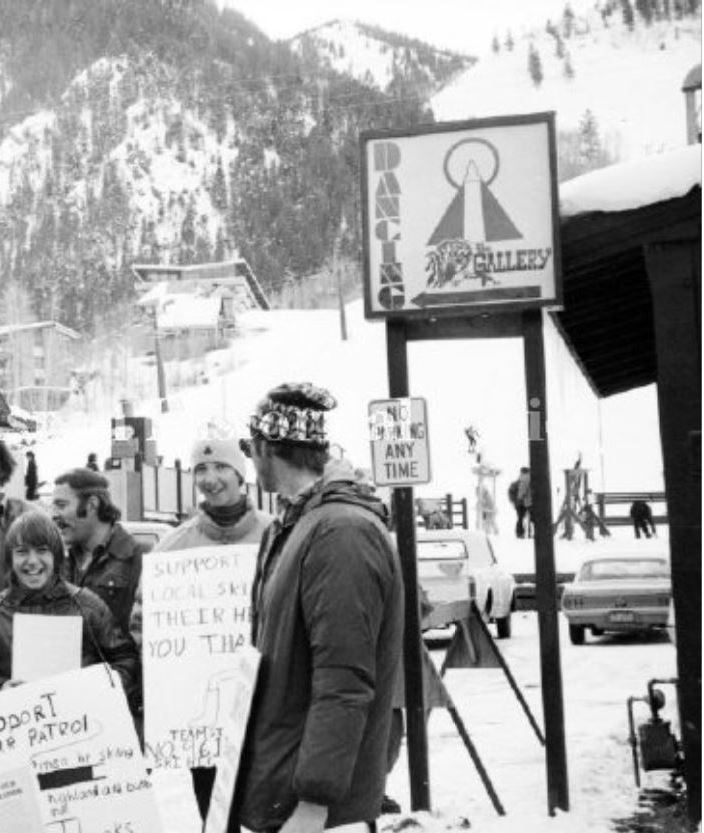
Below: The outside of The Gallery can be seen in this photo from a ski patrol strike in Aspen shortly before Christmas in December 1971.
The band’s recollections of the Gallery shows:
Randy Meisner: “The Gallery in Aspen was a small dance bar where everybody just danced and drank until they fell down…We went up there for a week or two, just to get to know each other’s playing. We did cover songs, maybe ‘Johnny B. Goode,’ some old blues songs, and a few originals that we were starting to write like ‘Witchy Woman.’.”
Glenn Frey: “I remember the first night, there were 40 people for the first set, then 80 people for the second set. By the fourth show of the night, it was packed. The word spread pretty quickly.”
Don Henley: “The shows at the Gallery club in Aspen were a somewhat different story. We always packed that place and people danced till the wee hours. At that point, we had a couple of original songs, but mostly we played cover tunes, repeating some of them as many as two or three times a night. But, the locals loved it.”
Randy’s wife, Jennifer, and a friend, drove down from Scottsbluff, NE to visit Randy during that week in Aspen.
Jennifer Meisner: “I drove to Aspen with my friend Barbara who had worked at the college with me. We stayed in the condo with Randy and Bernie. We had a great few days there…went to the club where they were playing. I made early Christmas cookies to take. It was beautiful weather. Randy took me around to all his favorite places. Barb stayed with Bernie….”
Tulagi
Boulder, Colorado
December 7-11, 1971
Hoping to secure Glyn Johns as their producer, David Geffen arranged for the band to return to Tulagi’s in Boulder to audition for him. Tulagi’s was normally closed in December while the students were away on Christmas vacation.

However, at the request of David Geffen, the club’s manager, Chuck Morris, kept the club open:
“I got a call from their manager at the time, David Geffen. He said, ‘I’ve got this new band I’m putting together. They`re on their way to England to record their first record. They`re going to be huge. I’d like them to play for five days, just to work out their material. Their producer’s going to fly in.’ So I canceled my vacation and kept the club open. About eight people came each night, but the band was brilliant. Glyn Johns would take notes, and after each [set] they’d go back to the bar and talk about it. It was tremendous.”
For these shows, the band was once again billed as Eagle, and only Bernie and Randy are mentioned in two of the ads.

Randy’s last name is misspelled as “Miesner” in this ad from the Boulder Daily Camera.

All four members are mentioned in this later ad from UC’s Colorado Daily. However, it contains several misspellings and incorrectly states that Glenn Frey was a member of Shiloh:

The band’s recollection of the Boulder shows:
Don Henley: “The show at Tulagi’s was basically an audition for British superstar record producer Glyn Johns, who had been asked by our management (David Geffen & Elliot Roberts) to come and see us perform in the U.S. Why they chose Tulagi’s in Boulder on a snowy December night is still a mystery to me. But Johns duly arrived at the Denver airport and I picked him up in a rental car and drove him to the club in Boulder. The roads were icy and snow was falling. There were about 6 or 7 people in the club and we played a lackluster set with which Mr. Johns was not impressed. The entire plan was wrong from the outset — the place, the timing, all of it.“
Tulagi interior and dance floor.

Since there were few people in the audience each night, the band could play what they wanted:
Randy Meisner: “We weren’t really a cohesive group as yet, although we did have that special sound. Still, it was more like an extended four-guy jam. We had a couple of songs, not many, that we did every night. ‘Witchy Woman’ was one of the first, and we did ‘Take It Easy,’ a Jackson Browne song, more R&B, because that’s the way Glenn played it; the recorded version came later. And a couple of Sonny Boy Williamson tunes. ‘Pontiac Blues,’ I’m sure we did that one every night. And a lot of Chuck Berry. Glenn loved to play Chuck Berry. We’d do four, sometimes five sets every night, and there were times when no one was in the house except maybe a bartender and a waitress or two, and a couple of hungry chicks. It was wild, kind of like what I imagine the Beatles went through in Germany.”
He also noticed that they more they played, the better they sounded:
Randy: “Everybody was just playing their own kind of way...But, as we played more, you could see we were getting tighter as a band and were using those gigs to boil down our song list to what really worked.”
“There was magic when we played live.”
Randy Meisner, 2009
Randy took every opportunity to record the band in those days with a little tape machine he had purchased: “There was magic when we played live. I recorded everything from rehearsals to shows.”
Since there was such a small audience at Tulagi, he decided to edit in applause from George Harrison’s Concert At Bangladesh to make it sound like a real concert at a big stadium. Randy told the story to radio personality, Redbeard, in 1989. Listen below:
“We played Tulagi’s and there was like three people there. At the time, Bangladesh was out, so I made a loop of the applause on Bangladesh and put it in back of this thing because the recordings were good because it was so quiet in there There were no people (laughs), so we get this ssshhhhh, this huge audience, it sounded just like it. The thing Glenn said, this great line at the end of it, the last night we played there, ‘I’d like to thank the waitresses all the way down to the management for having us here.’ (laughs)”
Glyn Johns, however, was not impressed:
“They played a selection of covers. Chuck Berry rock and roll kind of thing. Bernie Leadon, a great country picker, on one side of the stage, and Glenn Frey, an average rock and roll guitar player on the other, with Don Henley and Randy Meisner being pulled in two directions in the middle. The sound was not that great, and I got no impression of the wonderful vocal harmony that they became famous for. All that, combined with a fairly bland, somewhat awkward stage presence convinced me that they were not worth pursuing, and I returned to London.”
Randy: “We were too much electric and not enough vocals for him.”
Glenn Frey: “Glyn Johns was an Englishman who loved American country music and didn’t think we could rock and roll. He used to say, ‘The Faces can rock and roll but not you guys.”
Bernie Leadon: “Glyn came to see us in Colorado and he didn’t much like what he heard. We saw ourselves as a rock & roll band with other abilities, trying to pretend we were the Stones without the weight to pull it off. He knew it. He’s produced them. He thought we were second rate.“
Eagles at Bernie Leadon’s home in Topanga Canyon, CA, 1971.

After the band returned to California, Geffen persuaded Johns to give the band another chance, so he attended one of their rehearsals at little place called Bud’s, just off Ventura Boulevard in Studio City:
Bernie: Only our connection to Geffen brought him back for a second look, which he still didn’t like. It wasn’t until one or two of us picked up acoustic guitars during a break and we began doing what we had been doing in vocal rehearsals that he sat up and took notice. It was like how Dillard & Clark was originally created: we sat, singing harmonies with acoustic instruments, and we were singing four-part harmony. He flipped out. ‘That’s it! You guys are out of your freakin’ minds doing this other shit. That’s it. If you want me to work with you I will, but I’m going to make the vocals happen.'”
Glyn Johns: “We decided to take a break for lunch and as we were exiting the building someone said, ‘Hold on, before we go, let’s just play Glyn ‘Most of Us Are Sad,’ a ballad that Randy Meisner sang the lead on, with the others singing harmony. Bernie and Glenn grabbed a couple of acoustic guitars and they played the song without bass and drums, with all of us standing in a group near the door, and there it was. The harmony blend from heaven. It knocked me clean off my feet.”
Shortly thereafter the band flew to London to record their debut at Olympic Studios with Johns at the helm. Read about it below:
Sources
Canyon Of Dreams: The Magic And Music Of Laurel Canyon by Harvey Kubernik, 2009
Desperados: The Roots Of Country Rock by John Einarson, 2000
Sound Man by Glyn Johns, 2014
The Story Of The Eagles: The Long Run by Marc Shapiro, 1995
To The Limit: The Untold Story Of The Eagles by Marc Eliot, 1997
Interview with Don Henley, Denver Post, October 9, 2015
“Glenn Frey And The Eagles: A Storied Part Of Boulder’s Music History” by Matt Sebastian, Daily Camera, January 19, 2016
“The Long Run Is Not Over For Eagles’ Frey” by Stewart Oksenhorn, The Aspen Times, September 4, 2010
“Randy Meisner Takes It To The Limit One More Time,” Ken Sharp, Discoveries magazine, September 2006.
Thanks!
This is FANTASTIC!!! Thank You so much Jessica! You are AMAZING!!! Merry Christmas!!!
Merry Christmas to you, Gwen, and thank you!
Many Jessica.. your posts and this blog are THE BEST!!
All the very best for Christmas and the New year.
Oops, many thanks!!!
Thanks so much, Marie! Merry Christmas to you!
Another interesting read. Thank you so much and a very Merry Christmas to you and yours
Merry Christmas, Judy!
I was there for two shows at Tulagi in December 1971. As I remember it I counted 12 people in the audience the first night and that the heat was not working and everyone was wearing their winter coats. The Eagles played two full sets for 12 people. Pretty amazing, and my friend and I loved them so much we went the next night as well, and as I remember there was a large crowd of around 30 people . They sounded great to us and they proved us right. It was like seeing the Beatles at the Cavern.
What a cool story, Tom! Thank you!
Thank you for this story