

In early 1975, the Eagles started work on their 4th studio album, One Of These Nights. It would be the last album to feature all four original members. It was also their first breakthrough success, with the album reaching #1 within the first month of its release. Below, we go behind-the-scenes and song-by-song.
Full page ad, Rolling Stone, July 3rd, 1975:

One Of These Nights was the first full Eagles album produced by Bill Szymzyck.1 It was recorded at the Record Plant in Los Angeles, CA and Criteria studios in Miami, FL. The recording took six months to complete.
One Of These Nights – Front and Back


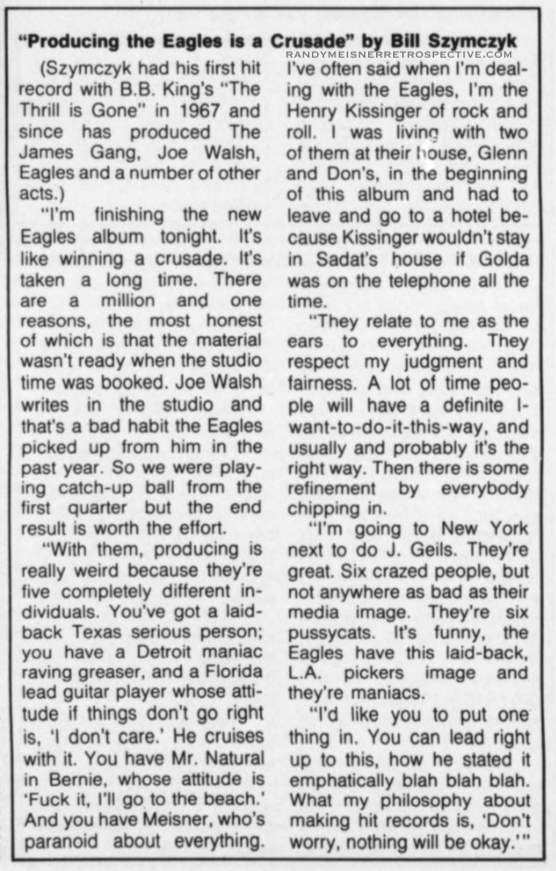
According to Szymzyck, recording with the Eagles was a challenge because of their very different personalities.
Szymzyck:
“With them, producing is really weird because they’re five completely different individuals. You’ve got a laid-back Texas serious person; you have a Detroit maniac raving greaser, and a Florida lead guitar player whose attitude if things don’t go right is ‘I don’t care.’ He cruises with it. You have Mr. Natural in Bernie, whose attitude is ‘Fuck it, I’ll go to the beach.’ And you have Meisner, who’s paranoid about everything.” 2
Eagles at Criteria Studios in Miami. Photo: Kazumasa Matsuo.

During rehearsals, each band member had a nickname that was used for the song’s working titles. Randy’s nickname during rehearsals was “Banshee.”
Below: One Of These Nights‘ recording engineer Michael Braunstein’s date book showing the week of March 30th-April 5th, 1975. Banshee = “Too Many Hands.”

Michael Braunstein describes what’s on the pages above:
“My Little Red Book, 1975, shows this was a busy week recording the Eagles in Studio B, RPLA. Got Zappa lacquers back for proofing on Tuesday. One of These Nights was the monster breakthrough album by the boys. Best display of their versatility of any LP, before or since. Those 3 singles charted 1, 1 & 4 with vox by Henley, Frey & Meisner. I see we tracked drums Friday with Szymczyk’s fave OHs: PML DC73s. That booth was the deadest. Also recorded the dueling outro solos on ‘Too Many Hands’ (working title: Banshee versus the… etc) w. Frey & Felder. They both used the same Fender Twin in that tiny sound lock, played from the control room. Great licks on that.”
Public Facebook post, 2015
(RPLA = Record Plant Los Angeles. PML DC73 = microphones. Lacquers = test acetates. Braunstein was the engineer for Frank Zappa’s One Size Fits All album.)
Songs
Track listing and credits from One Of These Nights‘ album inner sleeve:

“One Of These Nights”
Written by Don Henley & Glenn Frey. Sung by Don Henley.
Randy Meisner: “I really liked ‘One Of These Nights.’ It was just a ballsy song. The bass part was fun. Very high vocals on the end, my God! (laughs) Henley always said, ‘Meisner could make dogs howl.’ (laughs).”3
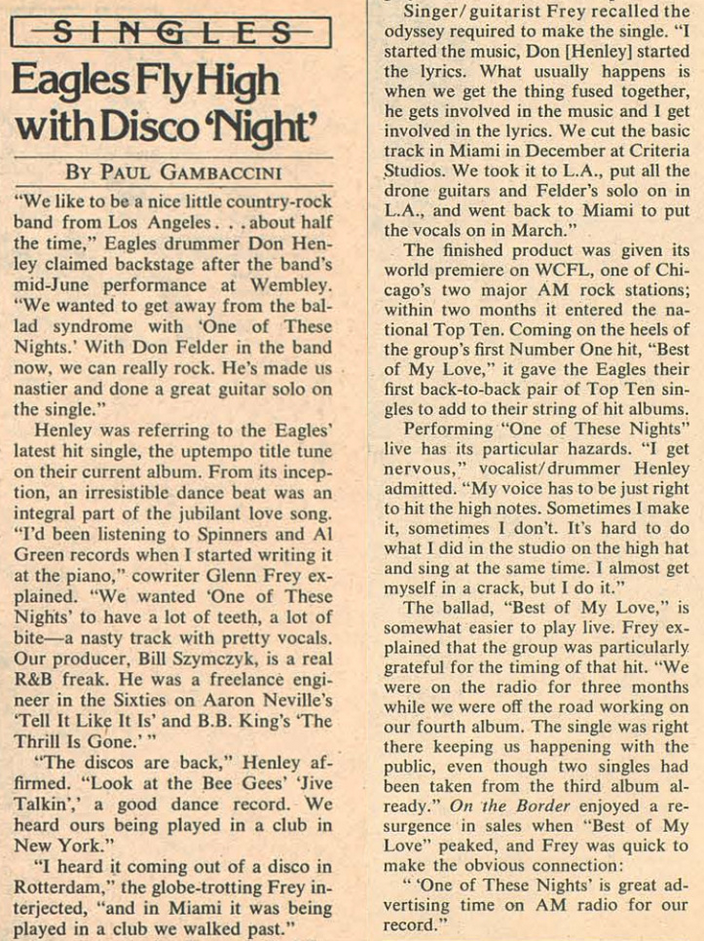
Glenn Frey: “I’d been listening to Spinners and Al Green records when I started writing it at the piano. We wanted ‘One Of These Nights’ to have a lot of teeth, a lot of bite. A nasty track with pretty vocals.” 4
1975 was the era of disco music and “One Of These Nights” is a nod to the genre.
Don Henley: “The discos are back. Look at the Bee Gees’ ‘Jive Talkin,’ a good dance record. We heard ours played at a club in New York.”
Glenn: “I heard it coming out of a disco in Rotterdam, and in Miami it was being played in a club we walked past.”5
In 2003, Glenn proclaimed “One Of These Nights” to be his favorite Eagles record.
Glenn: “It was a breakthrough song. It is my favorite Eagles record. If I ever had to pick one, it wouldn’t be ‘Hotel California’; it wouldn’t be ‘Take It Easy.’ For me, it would be ‘One Of These Nights.’6
On May 10th, 1975, the Eagles debuted the “One Of These Nights” single on WCFL in Chicago during Larry Lujack’s radio show.


“Too Many Hands”
Written by Randy Meisner & Don Felder. Sung by Randy Meisner.
Randy’s tribute to the planet was the second song on Side One.
Randy: “One song I wrote is called ‘Too Many Hands.’ It’s one…that I’m glad I was involved with and able to write because it’s almost coming true now. It’s about destroying our Mother Earth and what I don’t like about destroying it. So maybe that’ll be a classic someday–when there’s nobody here to play it. (laughs)” 7
Don Felder: “‘Too Many Hands’ was a raucous rock-and-roll number with a rhythm guitar riff that Don and Glenn had really liked and with toe-to-toe guitar solos by Glenn and me…That song actually made my hands bleed. The basic track was played on a twelve-string acoustic guitar, which you need the hands of a gorilla to play, because it just eats you up.” 8
Michael Braunstein, an engineer on One Of These Nights, believed that “Too Many Hands,” in addition to being a song about the planet, was also a patriotic song. Between 1975 & 1976, America was gripped with what could only be called “Bicentennial fever,” due to the 200th anniversary of the signing of the Declaration of Independence on July 4th, 1976.
Braunstein:
“1975-76 were not ordinary years in this country. America — the world, for that matter — was hyper-aware of the Bicentennial of our Declaration of Independence. Americans loved their country in the mid-70s while acknowledging that even after 200 years, America remained a ‘work in progress.’ Among the groups I engineered albums with over that period were Eagles, Frank Zappa, Grand Funk. All three released songs in reference to the Bicentennial year. This first is the Eagles ‘Too Many Hands,’ by far my favorite. (From the ‘One of These Nights’ album.)”
“The context must include that the lyric is written and sung by fellow Nebraska native Randy Meisner, Eagles’ founding member and original bass player. Randy grew up on a farm in the Sandhills of Western Nebraska which informs his character and values. Randy’s nickname in the band was ‘Banshee.’ Another informative part of this song is that the working title on the track sheets and the 2” tape box was ‘Banshee vs. the Cave [blanks]’. It could allude to almost anything and a patriotic viewpoint is one.
I’m not friends with Randy, haven’t seen him in 20 years or more. We have had some conversations in the past, both in the studio and sitting next to each other on plane flights. This song, of the three, is the most arcane; has double meanings as much good poetry does. View the lyric in context of 1976, of America struggling in certain theaters around the world and perhaps seeing Lady Liberty as being taken advantage of and in jeopardy. But never underestimate the Lady: Her fire is still burning. (Just put yourself in the mindset of, well, you know…)”
–Michael Braunstein, 2015

Get more details about “Too Many Hands” in my blog post about the song. Click here.
“Hollywood Waltz”
Written by Tom Leadon, Bernie Leadon, Don Henley, and Glenn Frey. Sung by Don Henley.
The original version of “Hollywood Waltz” was written by Tom Leadon, Bernie Leadon’s younger brother. Tom had been a founding member of the Gainesville, Florida band Mudcrutch in the early 1970s, along with Tom Petty and Mike Campbell.
Mudcrutch, c.1971.
L-R: Tom Leadon, Tom Petty, Randall Marsh, Mike Campbell.

In the Spring of 1973, Tom was living with Bernie in Topanga Canyon when he noticed the acacia trees blooming and thought it would be a cool thing to write about.
Tom, who passed away in 2023, described how his song ended up on One Of These Nights in an interview with gainesvillerockhistory.com:
“When I first lived with my brother [Bernie Leadon] in Topanga in 1973, that spring there were acacia trees blooming bright yellow all over Topanga Canyon and I was with him in his truck, and mentioned that would be a cool thing to write about, something about the acacias are blooming, and then my girlfriend was moving out from Gainesville to rejoin me there, and I wrote a song that was in ¾ time with that beginning, just like the Eagles, the first and last line of the first verse was what I wrote in my song. When I saw my brother I played it for him and he liked it.
“A couple years later the Eagles were down in Miami working on the ‘One Of These Nights’ album. And I was working down at the Scotch and Sirloin [at Pico and Sepulveda in Los Angeles] …and got a message to call him, so I went to the pay phone and called him, and he asked me from Miami how that song went and I sang it to him over the phone a bit, and he said he was going to show it to Glenn and Don, and they might want to rewrite a lot of the words and I said tell them to do it however they want. And they did that and recorded it as ‘Hollywood Waltz’ and that’s how I cowrote that song with them. I think I called it ‘The Acacias Are Blooming,’ it was mostly about Topanga Canyon. So that was a really interesting way to cowrite a song. I didn’t ask to hear it or give approval because I knew they were in Miami in the middle of recording an album, and that Bernie was trying to come up with something for the album, and he generally wrote a couple of songs on each album, and I knew that if I put any kind of delay on it or any kind of stipulation that they might decide well we won’t do this. I had enough respect for them as songwriters. They made it into a Hollywood Southern California thing to fit the concept of the album, kind of philosophically about life in L.A.
“It helped a lot, and was a real education in the music business; I learned about publishing and how people can rip off your publishing and I didn’t get all the money I was supposed to get but I did get a lot of it. I’m grateful to my brother for that.
“Music is a great thing as you know.”
Below, Randy included Tom Leadon’s verse about the acacia trees, along with his signature, on a copy of One Of These Nights:
“Spring time, and the acacias are blooming,
Southern California will see one more day.”

“Journey Of The Sorcerer”
Written by Bernie Leadon. Instrumental.
Although the other band members were not thrilled with “Journey Of The Sorcerer,” producer Bill Szymczyk championed it. The track’s working title was “Fellini In Florida.”
Bill Szymczyk:
“At the time Bernie had only one song on the album… this instrumental thing he wanted to do. Well nobody else in the band was in favour of it but I liked it so we worked on it, adding strings, backward guitar and some space sounds to the basic banjo track. The working title of the track was ‘Fellini In Florida.’ On the album the title was ‘Journey Of The Sorcerer’ and, years later, the song became the theme music to the British television series The Hitch-Hiker’s Guide To The Galaxy.” 9
Bernie describes the song to John Beaudin here.

“Lyin’ Eyes”
Written by Glenn Frey and Don Henley. Sung by Glenn Frey.
The inspiration for “Lyin’ Eyes” happened one night at Dan Tana’s restaurant on Santa Monica Boulevard in Hollywood. The story goes that Don, Glenn, and a few others, were sitting at one of the horseshoe-shaped booths when they noticed a beautiful young woman sitting at the bar with an older man and Glenn said, “Look at those lyin’ eyes.” Although parts of the song were written at the table on napkins, the rest was written at a house Don and Glenn shared on Briarcrest Lane in West Hollywood.
Glenn Frey: “The house was up on Briarcrest Lane. That’s where we wrote ‘One Of These Nights,’ ‘Lyin’ Eyes,’ ‘Take It To The Limit,’ ‘After The Thrill Is Gone,’ and a couple of other tunes for the One Of These Nights album. But ‘Lyin’ Eyes’ — the story had always been there. I don’t want to say it wrote itself, but once we started working on it, there were no sticking points. Lyrics just kept coming out, and that’s not always the way songs get written. I think songwriting is a lot like pushing a boulder up a hill. I’d love to get the legal pad for ‘Lyin’ Eyes’ again, because I think there were verses we didn’t use.”
Don Henley: “Glenn’s pretty much responsible for that track and for the title, the choruses. I helped out with the verses and perhaps with the melody. It’s really Glenn’s baby.”

“Take It To The Limit”
Written by Randy Meisner, Glenn Frey, and Don Henley. Sung by Randy Meisner.
The song that would become Randy’s masterpiece was the second track on Side Two.
Producer Bill Szymczyk recalled that it took a long time to record Randy’s voice for “Take It To The Limit.” He’d also suggested that the band listen to a certain R&B classic for inspiration.
Szymczyk:
“Recording Randy’s voice when we recorded that song took a bit of time, but his voice was perfectly suited to that. I was really influencing the Eagles insofar as my greatest love in music has been black music and rhythm and blues, and I had been turning those guys on to all these various records… The tune of ‘Take It To The Limit’ is based on ‘If You Don’t Know Me By Now’ by Harold Melvin and the Blue Notes – I told them to listen to that record, because it was really good. So Randy started to write a real laid back three-chorded thing, and we put the strings on it. I like that record too, even though it took a little time for Randy to do it. He’s got a great voice.’
“Take It To The Limit” became the Eagles’ first million-selling single, even though it was never pushed as a single by the band or record company. Instead it was radio driven:
Randy:
“What was nice about that it was never really promoted. It was the radio people who chose it without pushing it. A lot of times you’ll push a single, but this one it was on-demand. It was because it was getting played so much, they had to release it as a single. So, that was actually a real nice feeling. And every time we would play it live it would always bring the house down. It was THE song–and it still works pretty good.” 10
Get more details about “Take It To The Limit,” listen to a studio outtake, hear live recordings and more in my blog post about the song. Click here.

“Visions”
Written by Don Felder and Don Henley. Sung by Don Felder.
“Visions” was the only Eagles song on which Don Felder sang lead. Because of this, it suffers vocally, in my opinion. But the track does contain one of Randy’s hottest bass lines, not to mention some sexually suggestive lyrics: “If I can’t have it all, just a taste will do. Just a taste of you.” It also contains the lyric about “El Chingadero.”
Don Felder:
“I also wrote a song called ‘Visions,’ for which Don provided some of the lyrics, the only Eagles track I ever sang lead vocal on. I penned that song at my house in Topanga. It was the most up-tempo track of the whole album. I was still not confident about my singing voice, especially not when I had Don’s to compare it with, but I tried really hard, and the fact that Don and Glenn deigned to let me sing it must have meant something, I reasoned, even if the track was sort of thrown onto the album at the last minute and I wasn’t especially proud of the vocals. At one point in the lyrics, Don and Glenn sing, ‘Play on, El Chingadero, play on.’ I learned later that chingadero is Spanish and loosely translates to ‘motherfucker.’”11

“After The Thrill Is Gone”
Written by Don Henley and Glenn Frey. Sung by Don Henley and Glenn Frey.
Henley and Frey share co-writing credits and co-lead vocals on this overlooked track whose title was inspired by B.B. King’s “The Thrill Is Gone.”
Glenn: “That record is a lot of self-examination, hopefully not too much. There was a lot of double-meaning and a lot of irony. ‘Any kind of love without passion/Well, that ain’t no kind of lovin’ at all…’ — pure Henley.”

“I Wish You Peace”
Written by Bernie Leadon and Patti Davis. Sung by Bernie Leadon.
“I Wish You Peace” could easily be looked at now as Bernie’s goodbye song. The track was co-written by his girlfriend at the time, Patti Davis, who was the daughter of then-California governor and future U.S. president Ronald Reagan and his wife, former actress Nancy Davis Reagan.
Bernie Leadon: “Patti essentially wrote the song and I wrote the second verse as well. I came up with the arrangement to record it.”
Henley and Frey, who had wanted no outside songwriters on the album, objected to it being included on One Of These Nights. But Leadon persisted, even going so far as to tell Henley, “I’m going to break your fucking arm if you don’t record it.” 12
Patti Davis would sometimes visit the studio during the recording of the album. Since she was the daughter of the governor, her security detail was always with her.
Engineer Michael Braunstein:
“Whenever Patti Davis showed up at the front desk, the receptionist had strict orders not to buzz her in without calling the control room first. [To be fair, that was de rigeur anyway because artists and engineers hated to be interrupted during sessions.]
When the call came that ‘Patti is in the building,’ joints were extinguished, mirrors were wiped clean and a general cleanup ensued. You could tell that the other band members were getting a little stressed about the State Police escort car in the parking lot. Whether those tensions were part of Bernie’s exit from the band or not, I don’t know. I just know it was always ‘different’ when the Governor’s daughter showed up.” (Braunstein, 2015)
Randy himself never had a problem with Patti.
Randy: “She was around, and she started doing some songwriting with Bernie. Glenn and Don didn’t care too much for it but I didn’t have any problem with it. Bernie’s relationship with Patti was not interfering with the band as far as I was concerned.” 13

One Of These Nights was released in June 1975 and was certified gold by the end of the month. It was their first album to hit #1 on the Billboard charts.
Below: The Eagles were presented with gold records by Elektra/Asylum promotions rep., Rip Pelley (third from right), after two sold-out concerts at Pine Knob Music Theater outside of Detroit, June 27th, 1975:

One Of These Nights would be a milestone album for the Eagles. Not only was it their first number one seller, but “Take It To The Limit” would be their first million-selling single. It was a huge album for Randy.
Randy: “I didn’t get to shine too often with the Eagles but One Of These Nights turned out to be a big album for me.” 14
According to Randy, it was also the album that changed the band financially.
Randy: “I’d say that happened when “One of These Nights” came out…I looked at Irving Azoff one day and said, ‘Boy, this is big time now.’ I could tell it was really working and all of a sudden we got hit with all this stuff. It became huge.” 15
Further Reading:
I’ve Always Been A Dreamer: The Story Of “Take It To The Limit”
“Too Many Hands”
One Of These Nights Tour Dates (with ads, reviews, photos and more)
Album Cover Photo Session
Notes
- Szymczyk produced all but two songs on the Eagles’ previous record, On The Border. ↩︎
- Crawdaddy, August 1975 ↩︎
- Interview with Randy by Ken Sharp ↩︎
- Paul Gambaccini, “The Eagles Fly High With Disco ‘Night,” Rolling Stone, August 28, 1975 ↩︎
- Paul Gambaccini, “Eagles Fly High With Disco ‘Night’,” Rolling Stone, August 28, 1975 ↩︎
- Cameron Crowe interview, 2003 ↩︎
- Interview with Randy by Joe Michaels of KBSG radio in Tacoma, WA, May 12, 1988 ↩︎
- Don Felder, Heaven and Hell: My Life in the Eagles (1974–2001), 2007 ↩︎
- Marc Shapiro, The Story Of The Eagles: The Long Run, 1995 ↩︎
- KBSG radio interview, May 12, 1988. ↩︎
- A more accurate translation of “El Chingadero” is “The Fucker.” Felder’s quote is from Heaven and Hell: My Life in the Eagles (1974–2001), 2007 ↩︎
- Interview with Bernie Leadon by John Beaudin, 2019 ↩︎
- Marc Shapiro, The Story Of The Eagles: The Long Run, 1995 ↩︎
- Marc Shapiro, The Story Of The Eagles: The Long Run, 1995 ↩︎
- Interview with Randy by John Beaudin, 2000 ↩︎

Love, love, love this album. Still sounds fresh today. Great, informative article. Thank you.
Much appreciated, Catherine.
Thanks as always, Jessica!
My pleasure!